FAQ
Quantum Photo Somatics — Frequently Asked Questions
These are the questions people ask most about Quantum Photo-Somatics — what it is, how it works, who it's for, and what to expect. If yours isn't answered here, get in touch.
About QPS
Quantum Photo-Somatics (QPS) is a registered somatic modality that uses calibrated light and prism to bring the visual, neurological, and somatic systems into coherence. Developed by Dr Michael Christian, PhD (Optometrist), across 33 years of clinical practice and 43,680+ documented sessions, QPS is registered with the IICT and backed by professional indemnity insurance. Rather than correcting symptoms, QPS redirects process — activating the way the whole system was designed to function.
While behavioural optometry focuses on the mechanics of the eyes — tracking, focusing, and coordination — Quantum Photo-Somatics works through the visual system to affect the whole body. QPS is a registered somatic modality that addresses posture, balance, movement, and emotional regulation. While Dr Michael Christian, PhD (Optometrist), utilises his clinical expertise in both fields, QPS is a distinct methodology registered with the IICT, designed to facilitate whole-body coherence rather than just visual performance.
QPS is a registered complementary therapy modality with the IICT, backed by professional indemnity insurance through BMS. It sits within the complementary therapy framework — working alongside conventional healthcare, not as a replacement for it.
Most somatic therapies work through touch, movement, or breath. QPS works through calibrated light entering the visual system — making it a somatic modality where the tool is light, not physical contact. Learn more about how QPS works →
About Dr Michael Christian
Dr Michael Christian, PhD (Optometrist), holds a PhD in Integrative Medicine, Board Certification with the Board of Integrative Medicine (North America), and is a Registered Optometrist (AHPRA). He is an Executive Member of the IICT. He has published two books and has 33 years of clinical practice with 43,680+ documented sessions. Read Michael's full story →
Yes. Dr Christian developed Quantum Photo-Somatics over 26 years, beginning with formal development around 2000, after initial clinical observations in 1995. He registered QPS with the IICT in 2019. The SEE Framework and AIM Framework are his original contributions.
About the Process
A QPS session is approximately one hour, in person, with Dr Michael Christian, PhD (Optometrist), in Melbourne. Michael assesses how the visual system is currently processing using calibrated light and prism, then facilitates adjustments that activate changes in posture, balance, spatial awareness, and neurological regulation. The work is gentle, non-invasive, and touch is optional and always consent-based. See session options and pricing →
Touch is optional in QPS and always consent-based. The primary tool is calibrated light entering through the visual system. This makes QPS one of the few somatic modalities accessible to people for whom touch-based therapies aren't suitable.
QPS is designed with consent at its centre. Touch is optional and always explicitly consented to. The primary tool works through the visual system without requiring physical contact. QPS is a complementary somatic modality and does not replace medical or psychological treatment for trauma.
No referral is needed. You can book a Quansultation directly. QPS can complement conventional medical care, physiotherapy, psychology, and other modalities.
Ready to experience QPS?
Book a Quansultation - one hour with Dr Michael Christian in Melbourne.
No referral, no commitment.
About Results and Outcomes
QPS focuses on the visual-somatic factors that often co-exist with conditions such as unexplained dizziness, chronic headaches, learning difficulties, poor balance, brain fog, fatigue, spatial anxiety, and vision-related challenges. Every person responds differently. QPS is a complementary somatic modality and does not replace medical or psychological diagnosis.
Many clients report noticeable shifts within the first session. However, QPS is a process, not a one-time intervention. The Quantum Activation Pack (3 sessions) exists for those who want to build on the initial experience.
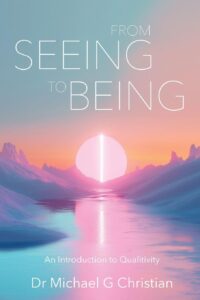
QPS is grounded in Dr Michael Christian's PhD research, 33 years of clinical practice, 43,680+ documented sessions, two published books (*In Focus: Vision, Mind & Body*, 2016, and *From Seeing to Being: An Introduction to Qualitivity*, 2025), IICT registration, and professional indemnity insurance through BMS.
About Pricing and Logistics
A Quansultation (your first QPS experience) is $420 AUD. Follow-up Quansultations are $360 AUD. The Quantum Activation Pack (3 sessions, no lenses) is $690 AUD. Full clinical packages through Microprism Vision range from $1,370 to $4,440 AUD. See all pricing →
QPS sessions are conducted in person at the Microprism Vision clinic in Melbourne, Australia. Clients travel from 8+ countries internationally.
How QPS Compares
Both are touch-based somatic modalities. QPS works through calibrated light entering the visual system, making it a somatic approach where touch is optional and always consent-based. No other somatic modality uses the visual system as its primary pathway. Read about the QPS methodology →
No. Light therapy uses specific wavelengths applied to the skin or eyes. QPS uses calibrated lenses and prisms to change how light is processed by the visual system. The mechanism is fundamentally different.
Vision and the Body
Complex visual environments place high demands on how the visual system processes spatial information. When the visual, neurological, and somatic systems aren't working in coherence, this can trigger dizziness or disorientation. QPS focuses on supporting the system's capacity to process complex visual input without triggering a stress response.
The eyes and neck are part of an integrated system. When the visual system isn't stable, the neck muscles often compensate. QPS works with the timing of how the visual and musculoskeletal systems coordinate — what we call phase coherence. QPS is a complementary modality and does not replace medical assessment of neck pain.
20/20 measures sight — the ability to see letters on a chart. Reading requires vision: the integrated processing of visual information alongside posture, balance, spatial tracking, and cognitive function. Dr Michael Christian, PhD (Optometrist), calls this distinction Qualitivity. QPS assesses and supports the visual-somatic dimension of learning.
The Nervous System
The eyes are a direct extension of the brain. How light is processed by the visual system directly influences the autonomic nervous system, including stress responses, rest states, and the sense of safety in the body. QPS uses calibrated light and prism to facilitate a shift from compensation toward coherence.
When the visual system works inefficiently, it draws disproportionate cognitive resources — leaving less capacity for thinking and concentration. QPS facilitates phase coherence, which may support the conditions for clearer cognitive function. QPS is a complementary modality and works alongside medical assessment.
Performance
Peripheral awareness depends on the brain feeling safe enough to let peripheral information in. QPS works with the visual-somatic factors that influence how broadly the system processes information. Several engineers, athletes, and performance-focused clients have found that QPS provides a measurable framework for understanding how vision affects function.
Vision affects the whole body. A standard prescription is calibrated for clarity, but may not account for how the body organises itself around visual input. QPS lenses — available through the full clinical pathway at Microprism Vision — are calibrated for the whole visual-somatic system.
Still Have Questions?
If your question isn't answered here, get in touch. Or if you're ready to experience QPS for yourself:
CLAIM YOUR FREE WELCOME GIFT
Sign up to the QPS email newsletter and get immediate access to the first chapter of Dr. Michaels new book, From Seeing to Being.

© 2026 QUANTUM PHOTO SOMATICS DESIGNED IN ATX BY GHOST FLOWER CREATIVE