METHODOLOGY
What Is Quantum Photo Somatics?
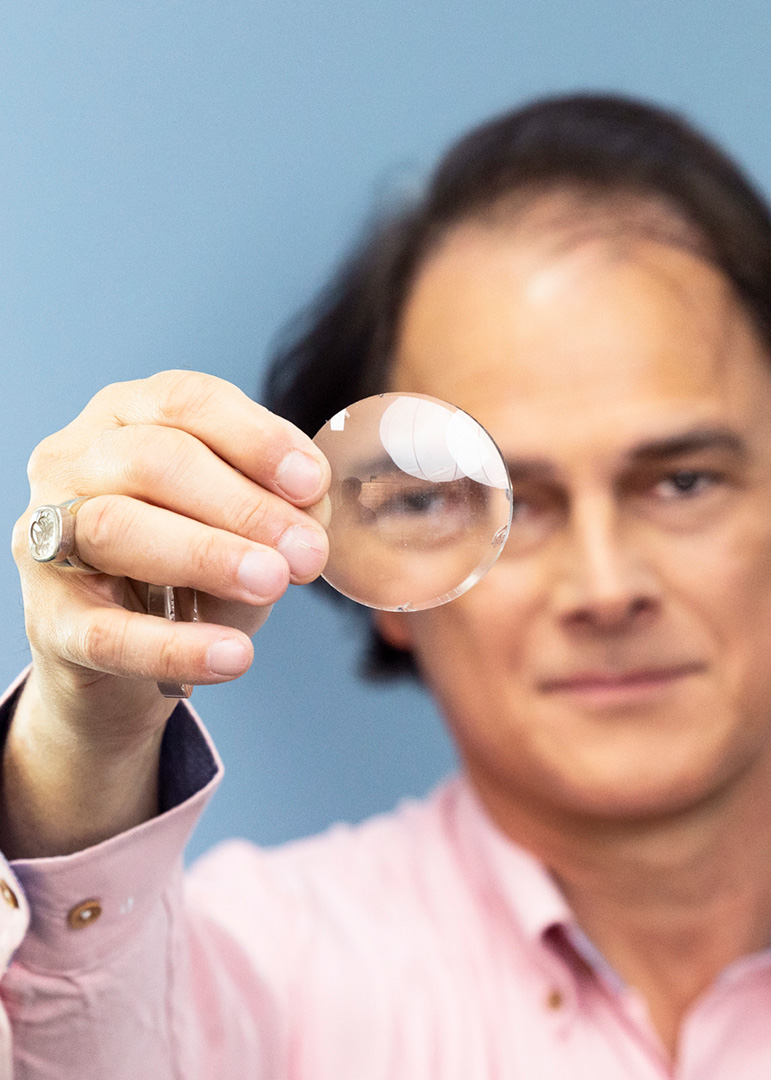
Dr Michael Christian, PhD (Optometrist) — Board Certified with the Board of Integrative Medicine (North America), Executive Member of the International Institute of Complementary Therapists (IICT), and Registered Optometrist (AHPRA) — has developed a modality that works through the visual system to affect the whole body. He calls it Quantum Photo-Somatics.
QPS is a registered somatic modality that uses calibrated light and prism to bring the visual, neurological, and somatic systems into coherence. Rather than focusing solely on symptom correction, QPS redirects process — supporting the way the whole system was designed to function in unity.
While conventional optometry focuses primarily on refractive prescriptions, QPS expands the scope to affect posture, balance, movement, cognition, and emotional regulation through the eyes. It is a light-based somatic therapy — the only registered modality that works through calibrated light and prism, and the only somatic approach where touch is optional and always consent-based.
Ready to experience QPS for yourself? Book a Quansultation — a one-hour, in-person session with Dr Michael Christian in Melbourne. No referral needed.
How QPS Works
Phase Coherence: The Principle
The body's systems don't operate in isolation — they operate in timing. The visual system, the neurological system, and the somatic system all work together, and when they're working well, they work in time with each other. Michael calls this phase coherence.
When phase coherence breaks down, symptoms appear in places that seem unrelated to vision: unexplained dizziness, chronic headaches, poor balance, fatigue, brain fog, learning difficulties, spatial anxiety. Conventional approaches treat each symptom separately. QPS works at the level of timing itself — facilitating the conditions for the whole system to come back into coherence.
The SEE Framework: Sense, Enable, Enact
Every QPS session follows the SEE Framework — a clinical process developed across 26 years of practice and 43,680+ sessions.
Sense: Michael assesses how the visual system is currently processing. Not just what you can see on a chart — but how your visual system is organising your posture, balance, spatial awareness, and neurological regulation. This is Qualitivity: quality-based measurement of visual and somatic function, as distinct from the purely quantitative metrics of conventional eye testing.
Enable: Using precisely calibrated lenses and prisms, Michael introduces shifts in how light enters the visual system. These aren't prescriptions in the conventional sense — they're calibrated activations that change how the body processes visual information. Many clients feel the shift in real time: posture adjusts, balance changes, spatial awareness opens up.
Enact: The body's capacity to integrate the new pattern is activated. This isn't something Michael does to you — it's something your system does once the conditions are right. The SEE Framework creates those conditions.
The AIM Framework: Activation, Integration, Motivation
For clients who move beyond a single session, the AIM Framework structures the therapeutic pathway.
Activation initiates the shift — the first session where calibrated light and prism open a new possibility for how the system organises itself.
Integration allows the nervous system time to consolidate change. The body doesn't reorganise overnight. Integration happens between sessions, at the pace of each individual's system.
Motivation sustains the new pattern through ongoing support — whether that's continued QPS sessions, the full clinical pathway through Microprism Vision, or a combination of both.
The Science Behind QPS
Why Light?
Light entering through the eyes doesn't just create vision. It carries information that affects how the entire nervous system organises itself — posture, balance, spatial orientation, emotional regulation, cognitive processing. This isn't new science. What Michael built is a clinical methodology for working with it.
Over 26 years, Michael documented a pattern that kept repeating: prisms adjusted for vision were changing posture. Lenses calibrated for clarity were affecting balance. Light entering through the eyes was reorganising the nervous system in ways that went far beyond what a standard prescription was supposed to do.


Qualitivity: Measuring What Matters
Conventional optometry measures what you can see on a chart — visual acuity, a number. Michael developed a different approach. Qualitivity measures how the whole system is functioning through what you see. It's quality-based measurement: not just "can you read line 4" but "how is your body organising itself around what your eyes are processing?"
This distinction — quantitative versus qualitative — is foundational to QPS. The chart tells you about the eyes. Qualitivity tells you about the person.
The Coherence Constant
Michael's emerging research framework connects mathematical phase relationships with clinical observations about how the visual, neurological, and somatic systems maintain a constant relationship when in coherence. The Coherence Constant is currently in development — bridging the theoretical foundation of QPS with the clinical patterns observed across 43,680+ sessions.
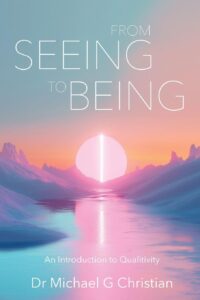
This research is documented across two published books: In Focus: Vision, Mind & Body (2016), which lays the theoretical and clinical foundation based on Michael's PhD research, and From Seeing to Being: An Introduction to Qualitivity (2025), which advances the framework into consciousness and presence. A third book is in progress.

Who is QPS For?
When Nobody Has Connected the Dots
People come to QPS when they've run out of conventional answers. They've seen the specialists. They've tried the prescriptions. The symptoms persist — and nobody has connected them back to the visual system.
QPS focuses on the visual-somatic factors that often co-exist with: unexplained dizziness or balance issues, chronic headaches, learning difficulties or processing challenges, brain fog and fatigue, spatial anxiety, postural issues with no clear structural cause, and vision-related challenges that standard prescriptions haven't resolved.
What these concerns have in common is a visual system that isn't functioning in coherence with the rest of the body. QPS works at that connection point.
QPS is a complementary somatic modality. It does not replace medical or psychological diagnosis. We work in conjunction with your healthcare team to support the visual-somatic dimension of these experiences.
Does this sound familiar? Learn how a QPS session works →

What the Methodology Makes Possible
A client living with albinism, nystagmus, and congenital cataracts arrived barely able to see 6/60. Her goal: "I want you to get me my driver's licence." Over seven years of working together through QPS, her visual system adapted — achieving functional outcomes that expanded what she and her previous practitioners had thought was available to her. She passed her driving test. She drives herself wherever she needs to go.
A young boy arrived with a psych report labelling him disruptive in class. Michael adjusted a prism by a quarter turn. The boy jumped up from the chair: "Mum, I can see those trees on the building over there! Mum, I don't feel heavy! Mum, I can do this!" One quarter turn of a prism — and the world changed. Not just what he could see, but how he felt in his body.
These aren't anomalies. They're what becomes possible when the visual system is brought into coherence with the rest of the body.
The Evidence Base
- 33 years of clinical practice, continuous application since 1993
- 43,680+ documented sessions across a diverse client base
- PhD research in Integrative Medicine documenting the relationship between vision, posture, balance, and whole-body function
- Two published books documenting the methodology, clinical frameworks, and outcomes
- IICT registration since 2019 with professional indemnity insurance through BMS
- International client base travelling from 8+ countries for QPS sessions
Clients consistently report shifts in balance, posture, clarity, and emotional regulation — often within a single session. The work is gentle, non-invasive, and progressive: each session builds on the last as the nervous system integrates new patterns.
About the Creator
Dr Michael Christian, PhD (Optometrist) — Board Certified with the Board of Integrative Medicine (North America), Executive Member of the International Institute of Complementary Therapists (IICT), Registered Optometrist (AHPRA). Creator of Quantum Photo-Somatics, the only IICT-registered modality that uses calibrated light and prism to bring vision, mind and body into coherence. 33 years of clinical practice. 43,680+ documented sessions. Author of two published books on the methodology.
Frequently Asked Questions
The SEE Framework — Sense, Enable, Enact — is the clinical assessment and activation process within Quantum Photo Somatics. Sense identifies how the visual system is currently processing. Enable introduces calibrated light and prism to shift that processing. Enact activates the body’s capacity to integrate the new pattern.
Phase coherence describes the timing of how the body’s systems work together. When the visual, neurological, and somatic systems are in phase coherence, the body functions as an integrated whole rather than a collection of compensating parts. QPS facilitates phase coherence through calibrated light and prism.
Light entering through the eyes doesn’t just create vision — it carries information that affects posture, balance, spatial awareness, neurological regulation, and emotional processing. When that light is calibrated using specific lenses and prisms, it can shift how the entire system organises itself.
Experience QPS
The best way to understand Quantum Photo Somatics is to feel it work.
A Quansultation is a one-hour, in-person QPS session with Dr Michael Christian in Melbourne. No referral needed. No ongoing commitment required. You experience the work, ask your questions, and decide if you want to go deeper.
CLAIM YOUR FREE WELCOME GIFT
Sign up to the QPS email newsletter and get immediate access to the first chapter of Dr. Michaels new book, From Seeing to Being.

© 2026 QUANTUM PHOTO SOMATICS DESIGNED IN ATX BY GHOST FLOWER CREATIVE