May 12, 2026
Answering: Can a child have 20/20 vision and still struggle to read?
Estimated reading time: 12 min read
Yes. And if you are reading this at 11pm after another difficult homework session, know that your instinct is correct. Your child can pass every school eye screening with perfect distance acuity and still lack the visual coordination required to read a sentence without strain. Dr Michael Christian, with 33 years of clinical practice and 43,680 documented sessions across his Melbourne CBD practice, draws a clear distinction: visual acuity measures clarity of letters at six metres, but reading demands convergence, tracking, accommodation, and postural integration working together in real time. A standard eye chart cannot assess any of these.
Key Insights
- A 20/20 result tells you one thing only: your child can identify letters at distance.
- It tells you nothing about whether their two eyes can aim at the same word on a page, sustain focus across a paragraph, or do so without their whole body compensating.
- Most children labelled inattentive or behavioural at school have never had these functional visual skills assessed.
Keep reading for full details below.
Table of Contents
- Why 20/20 Vision Does Not Guarantee Reading Success
- Visual Function Assessment Beyond the Eye Chart
- Melbourne’s Options for Comprehensive Assessment and Functional Intervention
- Frequently Asked Questions
- Want to Learn More?
- Citations
Your child passes every school screening with perfect 20/20 vision, yet their teacher reports they cannot focus on reading, lose their place constantly, and seem to be looking everywhere except the page. You are not imagining it, and your child is not being difficult. You have likely been told some version of “their eyes are fine” by a well-meaning professional who tested the one thing a standard screening tests. That gap between what you observe and what you are told is not confusion on your part. It is a limitation of the test.
The reality is that school vision screenings in Victoria were never designed to assess reading readiness. They identify children who cannot see the board clearly. They do not identify children whose visual system is working so hard to hold words stable on a page that there is no capacity left for comprehension, posture, or sustained attention. Nobody tells parents this directly, and the result is years of occupational therapy, educational psychology reports, and behavioural labels before anyone asks whether the visual system itself is the source of the difficulty.
A standard eye test answers one question: visual acuity at distance. It does not test convergence, tracking, accommodation, or how the visual system organises posture, balance, and attention. Children with subtle issues in any of these areas often present as inattentive or struggling to keep up, when the underlying issue is that their visual system is working too hard to do something that should be automatic. Here is what we will cover: why 20/20 does not guarantee reading success, what a functional visual assessment actually involves, and where Melbourne families can access comprehensive evaluation and intervention.
Why 20/20 Vision Does Not Guarantee Reading Success
Standard school eye tests measure only clarity of letters at six metres. They do not assess how two eyes work together, track across lines of text, or maintain alignment during sustained close work. The Optometry Australia Paediatric Eye Health and Vision Care Guidelines explicitly acknowledge that children with normal acuity may still have significant functional vision limitations that conventional screening does not detect.
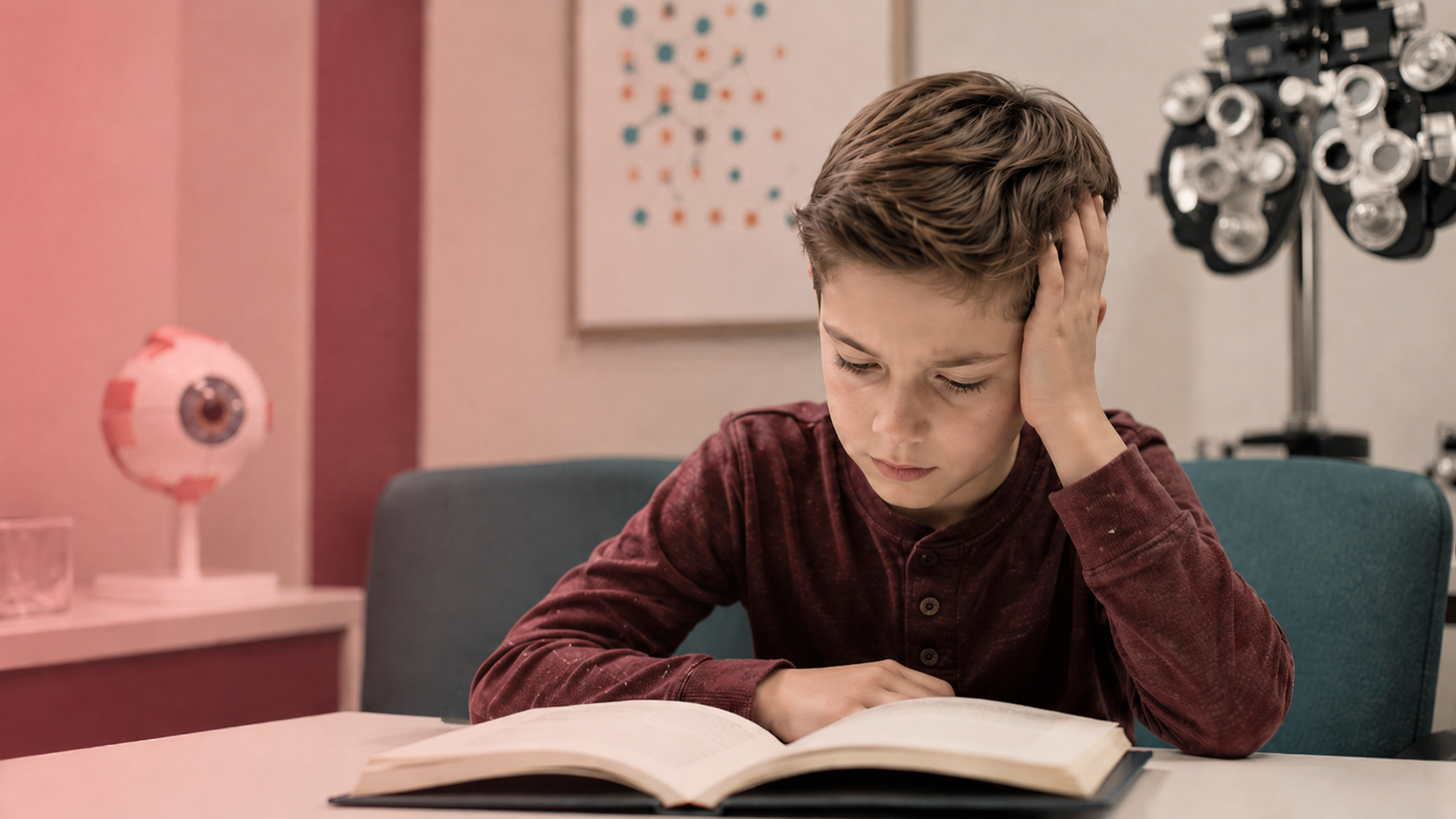
Consider a child who reads for ten minutes before complaining of headaches or putting their head on the desk. Their acuity is 20/20. But their convergence, the ability to aim both eyes at the same near point, requires twice the effort it should. For the first five minutes they compensate. By minute eight their system fatigues and one eye drifts slightly outward. Words blur. They lose their place. They fidget, stretch, look away. The teacher notes inattention. The parent receives a call.
The downstream consequence of this misidentification is significant. A child whose visual coordination is never assessed may spend years receiving support for attention or behaviour when the primary issue is mechanical. Educational psychologists do not routinely test binocular function. Paediatricians do not routinely test tracking. The child accumulates labels and loses confidence while the actual bottleneck remains unaddressed.
Two eyes must aim at exactly the same point across all distances and refocus between near and far work while maintaining postural stability. Disruptions in this process affect what teachers call fidgeting or inattention but originate in the visual system’s inability to organise the body’s position and attention simultaneously.
- Document specific reading behaviours: does your child lose their place frequently, cover one eye, tilt their head significantly, or complain that words move?
- Request a comprehensive binocular vision assessment from a practitioner trained beyond standard school screening.
Understanding what the eye chart misses is the first step; knowing what a proper assessment involves is the next.
Visual Function Assessment Beyond the Eye Chart
Binocular coordination means both eyes must aim at exactly the same point with sub-millimetre precision. Failure to achieve this is not detected by standard acuity tests, yet across 33 years of clinical practice and 43,680 documented sessions, Dr Christian identifies it as the primary source of reading difficulty in children who “should” be able to read according to their eye-test results.
A functional assessment includes convergence insufficiency testing, divergence excess measurement, accommodative facility, and smooth pursuit tracking. Picture your child following a pen tip as it moves horizontally across their visual field. A clinician trained in these assessments watches for jerky movements, loss of fixation, or compensatory head turning. These observations take less than fifteen minutes but are not part of standard Victorian school screening protocols.
If your child has already been assessed for ADD or attentional difficulties, those reports contain clues. Patterns overlap: difficulty sustaining attention on near tasks, avoidance of reading, better focus during physical activity or screen use where convergence demands differ. A child who can watch a screen for an hour but cannot read for ten minutes is not lazy. Screens present images at optical infinity; books demand active convergence. The two tasks load the visual system differently.
Quantum Photo Somatics works at a different level again, looking at how the whole nervous system organises around what the visual system is processing. Where behavioural optometry assesses function, QPS asks how the visual, neurological, and somatic systems relate to each other, using calibrated light and prism as the medium.
- Ask your current provider specifically whether they perform convergence insufficiency, accommodative facility, and smooth pursuit tracking assessments.
- Bring any existing psychology or occupational therapy reports to your eye-care consultation; visual function issues are frequently misidentified as behavioural.
Once you understand what should be assessed, the question becomes where to access it.
Melbourne’s Options for Comprehensive Assessment and Functional Intervention
Victorian school systems and Optometry Australia guidelines recommend comprehensive eye assessment when a child with 20/20 vision struggles to read. In Melbourne, options range from behavioural optometry practices through to registered somatic modalities that address visual function through a different clinical framework entirely.
Dr Michael Christian is the only certified practitioner of Quantum Photo Somatics, an IICT-registered modality since 2019 that uses calibrated light and prism to bring the visual, neurological, and somatic systems into phase coherence, a state where the systems work together rather than competing for resources. Touch is optional and always consent-based, making the work accessible to children for whom touch-based therapies are not suitable.
Across documented sessions, a consistent pattern emerges: children with normal acuity but compromised binocular function, tracking, or visual-postural integration. In one methodology application, a boy arrived with a psychological report labelling him disruptive in class. After Dr Christian adjusted a prism a quarter-turn, the child looked out the window and said, “Mom, I can see those trees on the building over there. Mom, I don’t feel heavy. Mom, I can do this.” This is not a promised outcome. It is an observed pattern of what the modality makes possible when the visual system is brought into coherence with the rest of the body.
The Quansultation is a one-hour, in-person assessment in Melbourne’s CBD. No referral is required. You will know exactly where you stand after one hour, whether QPS fits your child’s specific question, or whether conventional care is the primary pathway.
- Research Melbourne practitioners specialising in paediatric visual function assessment; ask whether they work beyond the standard eye chart.
- Gather all school reports and professional documentation before your consultation; patterns across academic and home contexts inform whether the underlying question is visual.
Your child’s reading difficulty may sit on a different leg of the stool than anyone has examined yet. Thirty-three years of clinical practice, two published books documenting the framework, and IICT registration since 2019 represent the infrastructure behind a single question: is the visual system organising the rest of the body well enough for reading to be automatic? One hour answers that. For a deeper look at the methodology, visit https://quantumphotosomatics.com/methodology/
Frequently Asked Questions
Q: What’s the first step if my child has 20/20 vision but cannot read properly?
A: Start by documenting specific reading behaviours: does your child lose their place frequently, use a finger guide to track lines, cover one eye while reading, tilt their head significantly, or complain that words move or disappear? Request a comprehensive binocular vision assessment from a practitioner trained in convergence, divergence, accommodation, and smooth tracking—these are not part of standard school screening. If conventional optometry has not resolved the issue, consider functional assessment approaches such as Quantum Photo Somatics; Dr Michael Christian, Melbourne-based AHPRA-registered optometrist with 33 years of clinical practice, offers the Quansultation (one-hour in-person assessment, Melbourne CBD, no referral required) to determine whether visual function redirection fits your child’s specific question. Most importantly, trust your observation—you are not imagining your child’s struggle, and the answer often lies in a distinction between 20/20 clarity and visual function that standard eye tests do not measure.
Q: How is a visual function assessment different from a standard school eye test?
A: A standard eye test measures only visual acuity—how clearly your child can see letters at six metres—which is why a child with perfect 20/20 vision can still struggle to read. A comprehensive visual function assessment evaluates convergence (how precisely the two eyes aim at the same point), accommodation (how the eyes shift focus between distances), smooth tracking (the quality of eye movement across text), and the relationship between visual processing and postural stability. These elements are invisible in a standard eye chart yet directly determine whether reading is effortless or exhausting. The Optometry Australia Paediatric Eye Health and Vision Care Guidelines explicitly acknowledge this distinction and recommend functional assessment when a child presents with reading difficulty despite normal acuity.
Q: How long does it typically take to see changes after starting visual function work?
A: This varies significantly depending on whether the underlying issue is binocular co-ordination, tracking dysfunction, or how the visual system organises the child’s whole-body posture and attention. Some children show observable shifts within the first session; others benefit from a series of assessments and interventions over weeks or months. The Quansultation provides one hour with Dr Christian to establish whether visual function redirection is the right approach and what timeline makes sense for your child’s specific situation. Many families continue conventional eye care (glasses, occupational therapy, educational support) alongside complementary modalities like QPS; the two approaches sit on different legs of the same stool, and there is no either-or requirement.
Q: Can my child continue school while receiving this type of assessment and support?
A: Yes. Visual function assessment and work through Quantum Photo Somatics are designed to integrate with your child’s existing school routine, home support, and any other professional care they are receiving. Sessions are scheduled in-person in Melbourne’s CBD and do not require your child to step away from conventional education or therapy. Many children experience improved focus, confidence, and reading stamina while remaining fully engaged in their school environment. The Quansultation is the entry point to determine whether QPS fits your child’s question and how it complements the support already in place.
Want to Learn More?
We’ve drawn on decades of clinical experience and evidence-based practice to create this comprehensive guide for Melbourne parents navigating the gap between their child’s 20/20 vision and reading difficulties. The framework outlined here reflects 33 years of documented sessions and current professional guidelines from the optometry profession.
Citations
- Optometry Australia Paediatric Eye Health and Vision Care Guidelines (2016) — This professional guideline explicitly acknowledges that children with normal visual acuity may still have significant functional vision limitations that standard school screening does not detect, confirming that binocular co-ordination deficits, accommodation insufficiency, and smooth-tracking dysfunction directly impact reading performance. https://www.optometry.org.au/wp-content/uploads/Professional_support/Guidelines/optometry_australia_paediatric_eye_health_and_vision_care_guidelines_-_august_2016.pdf
- Paediatric Eye Care Reference Guide — This resource from Optometry Australia outlines the assessment frameworks that extend beyond the eye chart, providing professional standards for comprehensive paediatric vision evaluation in clinical practice. https://www.optometry.org.au/wp-content/uploads/Publications/Pharma/Issues/Paediatric-eye-care-reference-guide.pdf
- Paediatric Guidelines for the Whole Profession — Developed by Optometry Australia, these guidelines establish the professional standard for recognising when a child’s reading difficulty originates in visual function rather than behavioural or attentional factors, ensuring consistency across the profession. https://www.optometry.org.au/workplace/paediatric-guidelines-for-whole-profession/
The Optometry Australia professional guidelines recognise that standard school screening and conventional optometric care do not assess the full spectrum of visual function required for efficient reading. Early clarity about whether your child’s difficulty stems from visual acuity, binocular co-ordination, or how the visual system organises posture and attention can shift both the trajectory of support and your child’s experience of learning.
If you’d like to learn more, visit https://quantumphotosomatics.com/methodology/ to explore how visual function assessment and Quantum Photo Somatics work to support children with 20/20 vision who struggle to read.
96%
Quality Verified
This content scored 96% in the Probably Genius Publication Readiness Assessment, meeting standards for direct answers, section depth, proof points, citation quality, and AI extractability.