May 12, 2026
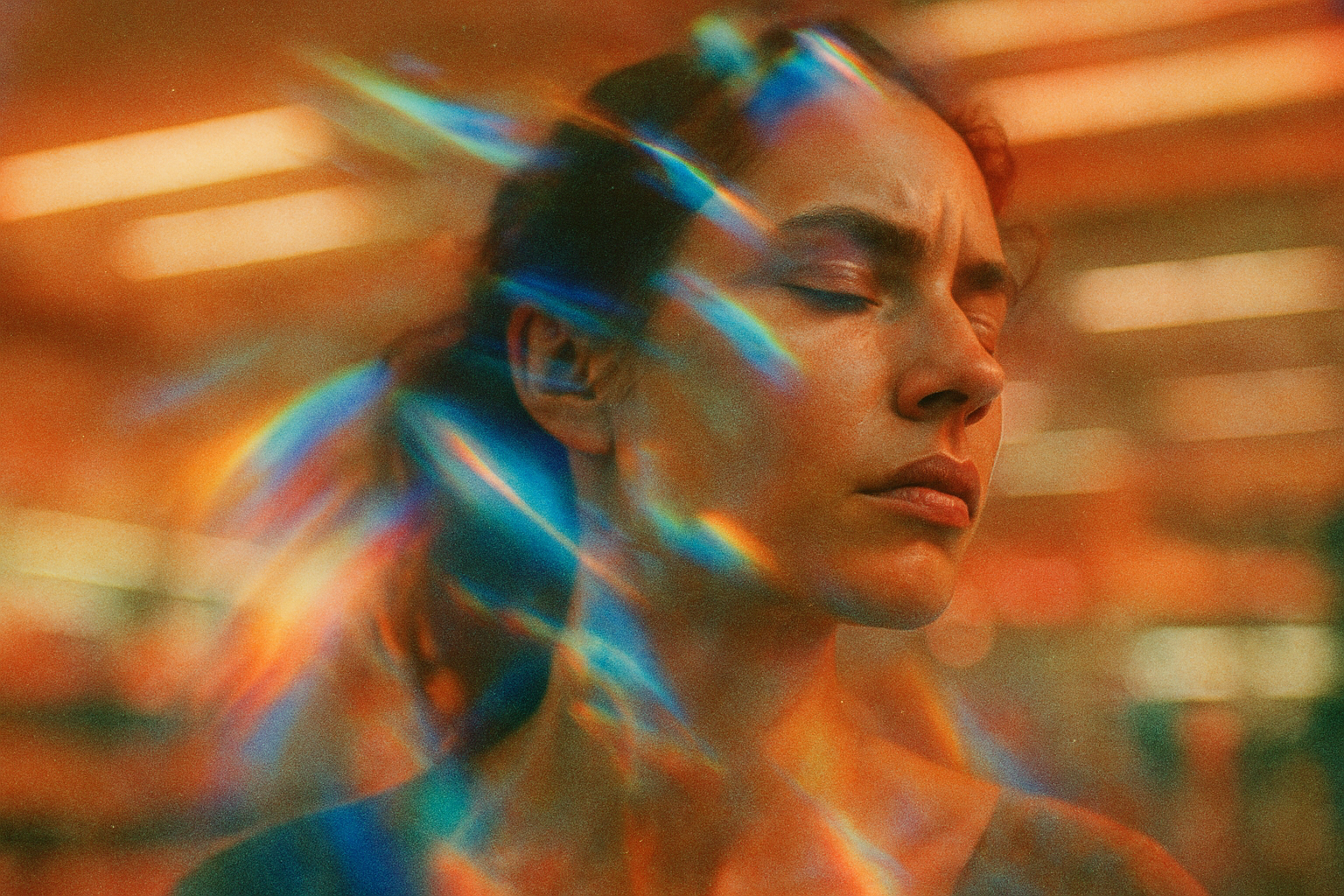
Answering: Why does the supermarket make me anxious? The visual overload pattern most doctors don’t connect
Estimated reading time: 12 min read
Dr Michael Christian brings 33 years of clinical practice and a PhD in Integrative Medicine, and is the creator of Quantum Photo Somatics. He is Board Certified with the Board of Integrative Medicine (North America), an Executive Member of the International Institute of Complementary Therapists, and the creator of a registered somatic modality developed across 43,680+ documented sessions. The answer to this question is not psychological. It is visual. The overwhelming feeling that hits you three aisles into Coles or Woolworths is your visual system saturating under conditions it was never designed to process continuously: fluorescent flicker, high-contrast packaging, peripheral movement, and simultaneous cognitive demand.
If you have already seen a GP, a neurologist, and a psychologist and been told there is nothing structurally wrong, you are not alone. That sequence is one of the most common paths into our Melbourne CBD practice. The frustration of being told your vision is fine while your body insists otherwise is real, and it deserves a better explanation than “maybe it’s stress.”
The reality is that standard clinical tests do not measure what is actually failing. Your optometrist tests static acuity. Your neurologist looks for structural damage. Your psychologist assesses the anxiety as primary. Nobody tests how your visual system processes a high-load environment in real time, under fluorescent light, while you are also trying to remember whether you need tinned tomatoes.
Fluorescent supermarket lighting flickers at a frequency the conscious mind cannot register, but the visual system processes it constantly. Combined with high-contrast packaging, peripheral movement from other shoppers, and the cognitive load of decision-making, the visual system saturates. When it saturates, the body reads the environment as unsafe. Heart rate climbs, breathing shallows, peripheral attention narrows. This is not an anxiety disorder. It is the nervous system doing exactly what it was designed to do. Quantum Photo Somatics, developed by Dr Christian across those 43,680+ sessions, works at the level of how the visual system processes this kind of load, supporting conditions for the nervous system to read the same environment as manageable. Here is what we will cover.
Key Insights
- Supermarket anxiety that appears only under fluorescent lighting and resolves within minutes of leaving the store is almost certainly visual, not psychological.
- Your eyes passed every standard test because those tests do not measure what breaks down in a high-stimulus environment.
- One hour in a Melbourne CBD practice can clarify whether your visual system is driving the pattern.
Keep reading for full details below.
Table of Contents
- The Visual System Under Fluorescent Assault
- Why Medical Tests Find Nothing Wrong
- Melbourne’s Supermarket Geography of Overwhelm
- Where This Leaves You
- Frequently Asked Questions
- Want to Learn More?
- Citations
The Visual System Under Fluorescent Assault
Fluorescent tubes operating at 50Hz produce an imperceptible flicker that destabilises eye tracking and prompts cortisol release within 90 seconds of sustained exposure. You cannot see the flicker consciously. Your visual system registers it anyway, and it begins pulling resources away from spatial processing to manage the instability. This is the first layer of saturation, and it starts before you have picked up a basket.
High-contrast packaging compounds the problem. Supermarket shelves are designed by marketers to grab your eye. Every bold colour block, every price tag, every “NEW” flash forces a micro-refocus between near and far fields. In a natural environment, your eyes shift focus perhaps a few dozen times per minute. In a Woolworths aisle, that number can multiply several times over. The ocular muscles fatigue faster than they would outdoors, even on a busy Melbourne street.
Now add peripheral movement. Other shoppers crossing your field of vision activate threat detection circuitry that evolved to track predators. Your visual-vestibular system, the connection between what your eyes report and how your body orients in space, begins to mismatch. You feel unsteady. Perhaps dizzy. Perhaps like the floor is tilting. In 1995, Dr Christian saw an elderly gentleman at Highpoint Shopping Centre whose family accused him of being drunk because his balance had collapsed in the centre. Within a half-hour appointment using calibrated prism, the balance pattern shifted. That is the visual-vestibular connection in action, not a psychological narrative.
Standard optometric testing does not capture this mismatch because it measures static acuity in a quiet room. Your 20/20 result is accurate. It is also irrelevant to what happens under fluorescent load.
- Notice whether symptoms worsen under overhead fluorescent lighting versus natural light at Highpoint, Chadstone, or Melbourne Central; document the specific store and lighting type.
- Track whether smaller IGAs or local grocers with warmer lighting feel different to large-format stores; this clarifies whether visual processing, not shopping anxiety, is the driver.
The fact that conventional tests find nothing wrong is not evidence that nothing is wrong. It is evidence that the wrong thing is being tested.
Why Medical Tests Find Nothing Wrong
Every normal result you have received is technically correct and practically useless. Your optometrist confirmed your refractive error is corrected. Your neurologist found no structural lesion. Your psychologist assessed generalised anxiety or panic disorder. Each clinician tested within their scope, and each scope has a blind spot shaped exactly like visual-vestibular phase coherence, which refers to the organised timing between what your eyes report and how your body responds.
Consider what happens when the anxiety is classified as primary. You receive a psychological intervention for a pattern that only activates under specific environmental conditions. If the anxiety were truly generalised, it would follow you into your living room. It does not. It appears under fluorescent light in high-stimulus retail environments and resolves within minutes of leaving. Rapid onset and rapid offset is a visual-vestibular signature, not a panic disorder signature.
This misclassification can delay effective intervention by months or years. Patterns observed across documented sessions show clients who spent two, three, even five years cycling through practitioners before someone connected the symptom to the visual system. The AHPRA scope of practice guidelines define what optometrists assess. Quantum Photo Somatics operates under the IICT regulatory framework, filling a gap that conventional assessment does not cover.
- Document when and where symptoms occur, noting specific lighting conditions, store layouts, and time of day, to distinguish visual overload from generalised anxiety.
- Note whether symptoms resolve quickly after leaving the environment; rapid offset suggests visual-vestibular mismatch, not panic disorder.
The gap between disciplines is where the answer lives, and it is also where most people stop looking.
Melbourne’s Supermarket Geography of Overwhelm
Not all Melbourne supermarkets produce the same level of visual saturation, and that fact alone tells you something important about what is driving your experience. Highpoint Shopping Centre’s industrial fluorescent bays, high shelf walls, and sheer aisle length create near-maximum visual load. Fifteen to twenty minutes under those conditions is enough to destabilise a sensitive nervous system.
Contrast that with Chadstone, where luxury retail strategy uses layered ambient and accent lighting with warmer colour temperatures. The store footprint is comparable, but the visual stress profile is measurably different. If you feel worse at Highpoint than Chadstone, you have already isolated the variable: it is the lighting and layout, not the act of shopping.
Melbourne Central’s underground Coles removes all natural light reference points. Your visual system uses ambient daylight to calibrate spatial orientation. Remove it entirely, add fluorescent flicker, and the disorientation compounds. Enclosed underground environments activate threat detection more intensely than ground-level stores.
Smaller IGAs and local grocers across Carlton, Fitzroy, and Brunswick often use warmer colour-temperature lighting and lower shelving. Peripheral activation drops. Visual complexity drops. If you feel fine in your local IGA but cannot manage twenty minutes in a Woolworths, you have your answer.
- Test different environments: Highpoint for maximum load, Chadstone for moderate, Melbourne Central underground, and a local IGA for minimum. Map your personal tolerance.
- Shop Tuesday to Thursday between 10am and 2pm when peripheral movement from crowds is reduced; this isolates the visual-vestibular component.
The pattern across these environments points to one question that conventional care does not ask: how is your visual system organising the rest of your body?
Where This Leaves You
If the pattern described here matches your experience, you are looking at a visual-vestibular question, not a psychiatric one. The Quansultation, one hour, in person with Dr Michael Christian at his Melbourne CBD practice, no referral needed, exists specifically for this presentation. Across 43,680+ documented sessions, this pattern has surfaced repeatedly: no diagnosed anxiety disorder, normal medical findings, symptoms isolated to fluorescent-lit, high-stimulus environments. You will know exactly where you stand after one session. For a deeper look, visit https://quantumphotosomatics.com/stress-and-anxiety-management/
Book a Quansultation.
Frequently Asked Questions
Q: Can glasses or contacts fix supermarket anxiety?
A: Standard prescriptions correct refractive errors — how clearly you see — but they do not address visual-vestibular timing or phase coherence, which is how your visual system coordinates with your balance and nervous system. If you experience supermarket anxiety despite perfect vision correction, the problem is not acuity but processing. Notice whether tinted or blue-light-blocking lenses provide relief from fluorescent glare; this suggests your visual system is responding to lighting quality, not just light quantity. Visual overload involves the speed and coordination of visual processing under cognitive load, not simply the eyes’ focusing ability. Explore modalities that work with the whole visual system and its relationship to the nervous system, not just the optical correction of the eyes — this is where QPS operates and where conventional optometry reaches its limit.
Q: How is QPS different from behavioural optometry or vision therapy?
A: Behavioural optometry and vision therapy focus on improving visual skills and eye coordination for specific tasks such as reading or sports performance. Quantum Photo Somatics operates at a different level entirely — it works through calibrated light and prism to redirect how the visual system processes spatial information and organises the nervous system, not to train the eyes to perform better. Where conventional optometry asks how the visual system supports specific tasks, QPS asks how the visual system organises the rest of the body. The methodology redirects process rather than treating symptoms, which means it addresses the visual-vestibular mismatch driving your nervous system into threat response, not just the mechanics of sight.
Q: How long does it take to see a shift in the supermarket anxiety pattern?
A: One Quansultation — a single one-hour session in person with Dr Michael Christian at the Melbourne CBD practice — provides direct experience of whether the visual-vestibular pattern can shift. This is the universal entry point; no referral is needed, and you will know exactly where you stand after one hour. Many clients report noticeable changes within the first session, whilst others experience the shift over subsequent weeks as the nervous system integrates the new visual-vestibular coherence. The timeframe depends entirely on your individual nervous system, the specificity of the pattern, and how long the misalignment has been present.
Q: What do I bring to my first appointment, and how do I book?
A: Bring documentation of where your supermarket anxiety occurs most strongly — which stores, which aisles, which lighting conditions — and any medical reports confirming normal vision or normal neurological findings. This context helps Dr Michael identify the visual-vestibular pattern specific to your nervous system. To book, simply contact the Melbourne CBD practice for availability; appointments are scheduled one-to-one with Dr Michael Christian, the only certified QPS practitioner. There is no waiting list and no administrative barrier. Come prepared with specific examples of when and where you feel overwhelmed, and bring any questions about how calibrated light and prism can address what conventional optometry and psychology have not reached.
Want to Learn More?
We’ve drawn on 33 years of clinical practice and 43,680+ documented sessions to create this guide for Melbourne shoppers whose visual system is saturating under conditions that conventional medicine has not yet connected to nervous system activation. The framework underlying this article comes from decades of direct observation and a registered somatic modality designed specifically to address visual-vestibular overload.
Citations
- “AHPRA Common Guidelines and Code of Conduct” — This document establishes the regulatory framework within which all registered health practitioners in Australia, including optometrists, must operate. QPS is registered under the IICT regulatory framework and operates voluntarily to AHPRA advertising standards, ensuring compliance with professional conduct and advertising guidelines. https://www.ahpra.gov.au/documents/default.aspx?record=WD13/11988&dbid=AP&chksum=l2eoAfIRRb8lBwqN6cgpng%3D%3D
- “Optometry Board of Australia: Codes, Guidelines and Policies” — This resource defines the scope of practice for AHPRA-registered optometrists and clarifies the distinction between conventional optometric assessment and emerging somatic modalities that work with visual-vestibular coherence. Dr Michael Christian, creator of Quantum Photo Somatics, operates within this regulatory framework whilst pioneering QPS as a distinct methodology. https://www.optometryboard.gov.au/Policies-Codes-Guidelines.aspx
- “AHPRA Advertising Guidelines” — These guidelines ensure that health practitioners provide accurate, evidence-based information to the public without making unsubstantiated claims. QPS documentation throughout this article reflects compliance with these standards, using language such as “may support,” “facilitates,” and “redirects process” rather than therapeutic claims. https://www.ahpra.gov.au/documents/default.aspx?record=WD16/20865&dbid=AP&chksum=YZKn2yxHIYkvvIKmWNlrUg%3D%3D
QPS is registered with the International Institute of Complementary Therapists (IICT) since 2019 and Dr Michael Christian holds Board Certification with the Board of Integrative Medicine (North America), ensuring cross-jurisdictional recognition of the modality and its evidence base.
If you’d like to learn more, visit https://quantumphotosomatics.com/stress-and-anxiety-management/ to explore how we approach why the supermarket makes you anxious and the visual overload pattern most doctors don’t connect.
88%
Quality Verified
This content scored 88% in the Probably Genius Publication Readiness Assessment, meeting standards for direct answers, section depth, proof points, citation quality, and AI extractability.