June 26, 2026
Answering: how visual strain may feed nervous-system load in burnout and screen fatigue, and what a visual-somatic approach to coherence may offer.
Estimated reading time: 11 min read
If your work lives on a screen, you may already know the late-afternoon version of yourself: eyes that feel gritty and slow, shoulders pulled toward your ears, a low hum of effort that does not switch off when you close the laptop. The World Health Organization now classifies burnout as an occupational phenomenon, a syndrome resulting from chronic workplace stress that has not been successfully managed. For many knowledge workers and executives in Melbourne, that load arrives partly through the eyes, and the visual strain rarely gets named as part of the picture. This article looks at how seeing and being are connected, and what visual-somatic coherence may offer people experiencing burnout and screen fatigue, as a complement to proper care rather than a substitute for it.
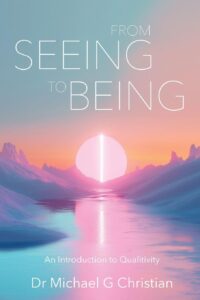
The framing draws on From Seeing to Being: An Introduction to Qualitivity, the 2025 book by Dr Michael Christian, PhD, the creator of Quantum Photo Somatics (QPS). It is not a clinical claim about curing burnout. It is a question worth sitting with: when your day is built on sustained looking, what happens to the body that does the looking, and can attending to that change how the rest of you feels?
Burnout recovery in Melbourne is usually framed around workload, sleep and boundaries, all of which matter. Less often discussed is the visual system, the part of you that meets the screen for eight hours and may be quietly adding to the nervous-system bill.
Key Insights
- Burnout is recognised by the WHO as an occupational phenomenon driven by chronic workplace stress, not as a medical disease, and screen-heavy work can be one contributor to the underlying load.
- Eye strain from prolonged screen use is associated with tired eyes, headaches, difficulty concentrating and neck and shoulder tension, all of which can add to nervous-system load.
- Quantum Photo Somatics is a complementary somatic modality that may support coherence between the visual system, nervous system and body. It does not treat, cure or solve burnout, and it does not replace medical or psychological care.
Keep reading for the complete guide.
Table of Contents
- What Burnout Actually Is, and Where Screens Fit
- Eye Strain and the Nervous System
- From Seeing to Being: Why Visual Coherence Matters
- What Visual-Somatic Coherence May Offer
- Where It Fits Alongside Proper Care
What Burnout Actually Is, and Where Screens Fit
Burnout has become a loose word for being very tired, but it has a more precise meaning. The World Health Organization includes it in the ICD-11 not as a medical condition but as an occupational phenomenon: a syndrome conceptualised as resulting from chronic workplace stress that has not been successfully managed. The WHO describes three characteristics: energy depletion or exhaustion, increased mental distance from one’s job or feelings of negativism and cynicism, and reduced professional effectiveness. The same source is careful to note that burnout refers specifically to phenomena in the occupational context and should not be applied to other areas of life.
That distinction matters for how we think about help. If burnout is fundamentally about chronic stress that the system has not been able to discharge, then anything that quietly adds to the daily stress load is part of the story, and anything that may help take load off the nervous system is worth understanding. Victoria’s Better Health Channel describes how the body responds to stress: when we feel under stress, the body kicks into high gear to deal with the threat, and heartbeat, breathing rate and blood pressure all go up. Sustained over months, that elevated state is the territory burnout grows in.
Screen-heavy work sits inside this picture in a way that is easy to overlook. Most conversations about executive stress focus on calendars and cognitive load, which are real. But the physical act of looking at screens for most of the waking day is itself a demanding task, and the strain it produces does not stay politely in the eyes. For anyone thinking about burnout recovery in Melbourne, the visual component is a piece that standard advice tends to skip.
- The WHO defines burnout as an occupational phenomenon, not a disease, driven by unmanaged chronic workplace stress.
- Stress puts the body into a high-gear state, raising heartbeat, breathing and blood pressure.
- Screen-heavy work adds a visual load that is rarely counted in burnout conversations.
Eye Strain and the Nervous System
Eye strain is more than tired eyes. Healthdirect Australia describes it as a common condition that occurs when you concentrate on something visually for extended periods, including using computers, smartphones, tablets and gaming consoles for a long time. Its listed symptoms reach well beyond the eyes themselves: tired, sore or itchy eyes, blurred vision, difficulty concentrating, light sensitivity, headaches, and tension in the neck, shoulders and back. That last cluster is the giveaway. The strain of sustained looking shows up as bodily tension, which is the same currency the nervous system trades in.
This is the connection between eye strain and nervous system that often goes unspoken. The eyes are not a separate department bolted onto the body. They feed a constant stream of information into the systems that govern balance, posture and the body’s automatic responses, and the muscles that move the eyes work in concert with the muscles of the neck and upper back. When you hold visual focus on a screen for hours, you are not only working the eyes. You are asking a chain of connected systems to stay switched on, and to keep doing it without a break.
Healthdirect also notes a small detail with large consequences: when concentrating on a screen, you tend not to blink as often, which leaves the eye surface dry and fatigued. Multiply that across a full working day and a working week, and a low-grade strain builds quietly underneath everything else. For someone already carrying the elevated state that stress produces, this added visual load is not the whole cause of burnout, but it can be one of the inputs keeping the nervous system from settling. Naming it is the first step to addressing it.
- Eye strain symptoms include headaches and neck, shoulder and back tension, not just tired eyes.
- The eyes feed the systems that govern balance, posture and automatic responses.
- Reduced blinking during screen work leaves the eyes dry and fatigued across a long day.
From Seeing to Being: Why Visual Coherence Matters
Dr Michael Christian’s 2025 book, From Seeing to Being: An Introduction to Qualitivity, takes its title from a simple observation: how you see shapes how you are. The book introduces what Qualitivity means, the idea that perception is not only about how much information you take in but about the quality of how your systems organise around it. In a screen-saturated working life, that organisation is under constant pressure, and the book explores how visual experience and bodily state are bound together.
The central concept is coherence: whether the visual, neurological and somatic systems are working in coordinated timing or are slightly out of step with one another. This is not about how sharply you can read a chart. It is about how your body organises itself around what you see, and whether that organisation is smooth or effortful. When the systems fall out of step, the result can be a cluster of persistent experiences, including visual fatigue, tension and a sense of being subtly braced, that never resolves into one neat explanation because it was never one problem.
This is where the bridge to burnout and screen fatigue becomes clear. The same coherence that From Seeing to Being describes is exactly what sustained screen work tends to erode. Hours of holding focus, suppressing blinks and bracing the neck and shoulders are, in this framing, hours of low-grade incoherence between seeing and being. Quantum Photo Somatics works in that territory, using calibrated light and prism to support the timing between the visual, neurological and somatic systems, an approach grounded in what Qualitivity means rather than in correcting eyesight. You can read more about what Qualitivity means in the dedicated explainer.
- Qualitivity describes the quality, not just the quantity, of how your systems organise around what you see.
- Coherence is the coordinated timing between the visual, neurological and somatic systems.
- Sustained screen work can erode that coherence, the same quality the book describes.
What Visual-Somatic Coherence May Offer
It is important to be precise about what is and is not being claimed here. Quantum Photo Somatics does not treat, cure or solve burnout, and recovery is never guaranteed. Burnout is the WHO-recognised occupational phenomenon described above, and addressing it properly involves the workplace, rest, medical care and, where appropriate, psychological support. What a visual-somatic approach may offer is narrower and more specific: a structured, complementary way of attending to the visual component of the load, which may help take some load off the nervous system.
In practice, QPS is concerned with how your body organises itself around what you see, rather than with sharpness of sight. A session may support the nervous system in settling into a more coordinated state, and some clients describe experiencing a sense of being more present or more grounded afterward. These are descriptions of lived experience, not promised outcomes, and they are shared as such. The relevant question for someone carrying screen fatigue is whether reducing visual incoherence is associated with feeling less braced, and that is a question best answered in conversation, not by a guarantee.
For knowledge workers and executives looking at somatic therapy for executive stress, the appeal of this angle is that it addresses a piece the standard advice leaves out. Boundaries and rest are necessary, but they do not touch the specific strain of sustained looking. A visual-somatic approach may complement those efforts by working with the system that meets the screen, while leaving the broader work of burnout recovery to the people and practices equipped for it. Touch in QPS is always optional and every session is consent-based, which keeps the experience within your control throughout.
- QPS does not treat, cure or solve burnout, and outcomes are never guaranteed.
- It may help take load off the nervous system by attending to the visual component of strain.
- Client experiences are shared as lived experience, not as promised results.
Where It Fits Alongside Proper Care
Quantum Photo Somatics is a complementary modality, which means it is designed to sit alongside the care you already receive, not in place of it. If you are experiencing burnout or significant screen fatigue, the first and most important steps remain conventional: speaking with your GP, addressing the workplace conditions driving chronic stress, and seeking medical or psychological support where it is needed. QPS does not replace any of that, and it should not be understood as an alternative to it.
Within that frame, the modality offers a defined and accountable place to attend to the visual-somatic piece. QPS has been registered with the International Institute for Complementary Therapists since 2019, which situates it within a recognised, insured category of complementary practice rather than an improvised one. It was developed by Dr Christian, who holds a PhD in integrative medicine, is board certified with the Board of Integrative Medicine in North America, and has refined the work across 33 years of clinical practice and more than 43,680 documented sessions. That history is offered as context for a complementary practice, not as a clinical claim about burnout.
The starting point is a one-hour, in-person Quansultation in Melbourne CBD, a conversation rather than a treatment, designed to give you clarity about whether the approach suits what you are experiencing. To understand the wider picture, you can read about what Quantum Photo Somatics is, explore the connection between stress, the body and visual tension, and look at how the eyes connect to the nervous system. The aim throughout is the same: to give you enough to decide calmly, with the facts in front of you.
- QPS is complementary and does not replace medical or psychological care for burnout.
- It has been IICT-registered since 2019, within a recognised, insured category of practice.
- The starting point is a one-hour, in-person Quansultation in Melbourne CBD.
Frequently Asked Questions
Q: Can Quantum Photo Somatics cure or treat burnout?
A: No. Burnout is recognised by the World Health Organization as an occupational phenomenon resulting from chronic workplace stress, and QPS does not treat, cure or solve it. QPS is a complementary somatic modality that may support coherence between the visual system, nervous system and body, and that may help take some load off the nervous system. It is designed to sit alongside medical and psychological care, never to replace it, and any improvement is never guaranteed.
Q: How is eye strain connected to the nervous system?
A: Healthdirect Australia notes that eye strain from prolonged screen use is associated not only with tired eyes but with headaches and tension in the neck, shoulders and back. The muscles that move the eyes work alongside the muscles of the neck and upper back, and the visual system feeds the systems that govern balance and automatic responses. Sustained screen work can therefore add to nervous-system load, which is part of why visual strain is relevant to burnout and screen fatigue.
Q: What does From Seeing to Being have to do with screen fatigue?
A: Dr Michael Christian’s 2025 book introduces Qualitivity, the idea that how you see shapes how you are, and centres on coherence between the visual, neurological and somatic systems. Sustained screen work tends to erode that coherence through held focus, suppressed blinking and bracing. The book provides the framework for understanding screen fatigue as a question of visual-somatic coherence rather than only of tired eyes.
Q: How do I start, and does this replace seeing my doctor?
A: The starting point is a one-hour, in-person Quansultation in Melbourne CBD, which is a conversation rather than a treatment. It does not replace seeing your doctor. If you are experiencing burnout or significant screen fatigue, conventional medical and psychological care comes first, and QPS is intended only as a complementary approach that may sit alongside it.
Want to Learn More?
Quantum Photo Somatics is the result of more than three decades of clinical practice, a doctorate in integrative medicine, and two published books, including From Seeing to Being, released in 2025. If you would like to understand the thinking behind the modality and how visual coherence relates to the load that screen-heavy work places on the nervous system, the methodology pages set it out in plain language, written for people who want to understand before they decide.
Citations
- “Burn-out an occupational phenomenon, World Health Organization”: The WHO confirms that burnout is included in the ICD-11 as an occupational phenomenon, not a medical condition, and defines it as a syndrome resulting from chronic workplace stress that has not been successfully managed. https://www.who.int/news/item/28-05-2019-burn-out-an-occupational-phenomenon-international-classification-of-diseases
- “Stress, Better Health Channel”: Victoria’s state health information service explains that workplace stress is common and that under stress the body kicks into high gear, raising heartbeat, breathing rate and blood pressure, the elevated state in which burnout develops. https://www.betterhealth.vic.gov.au/health/healthyliving/work-related-stress
- “Eye strain, Healthdirect Australia”: The Australian Government health service describes eye strain from prolonged use of computers, smartphones and tablets, listing symptoms that include headaches and tension in the neck, shoulders and back, alongside tired eyes and reduced blinking. https://www.healthdirect.gov.au/eye-strain
As a registered modality, QPS operates within the IICT professional code of conduct and the general standards that apply to complementary therapy advertising in Australia, which require that no therapeutic claims of cure or treatment be made.
✓Verified