July 15, 2026
Answering: Is there a somatic option in Melbourne for people who do not want to be touched, and how does consent-led, touch-free body work actually work?
Estimated reading time: 9 min read
Yes. If you want body-based work but the idea of being touched is a barrier, there is a somatic option in Melbourne built around exactly that. Quantum Photo Somatics is a complementary somatic modality, registered with the International Institute for Complementary Therapists (IICT) since 2019, in which touch is optional and every session is governed by a clear consent framework. It was developed by Dr Michael Christian across 33 years of clinical practice and more than 43,680 documented sessions, and he is board certified with the Board of Integrative Medicine in North America. Rather than working through hands-on manipulation, his method works through light and the visual system, which is why it can be offered as genuinely touch-free. It does not treat or cure any condition, and it is designed to sit alongside your medical and psychological care, never to replace it.
For a lot of people, the wish for body work and the fear of being handled sit side by side. You sense that something is held in the body and that talking has not reached it, and at the same time the thought of a stranger’s hands on you, however skilled and well meaning, closes the door before you have walked through it. If that is you, you are not being difficult, and you are not alone. This guide explains what no-touch, consent-led somatic work means, how QPS delivers it, and how to tell a dignified, accountable version from an improvised one.
Definition: What is no-touch, consent-led somatic work?
No-touch, consent-led somatic work is body-based practice that engages the nervous system without physical manipulation, and in which your explicit, ongoing consent governs everything that happens. “Somatic” simply means relating to the body. “No-touch” means the work reaches the body through channels other than hands-on contact, in the case of Quantum Photo Somatics through light and the visual system. “Consent-led” means the arrangement is agreed and revocable at every step, rather than assumed. In this model touch is not withheld as a rule so much as it is optional by design, offered only if you want it and never as the mechanism the work depends on.
Key Insights
- Quantum Photo Somatics is an IICT-registered complementary modality in which touch is optional and every session runs on a clear consent framework; it does not treat or cure any condition and is designed to sit alongside medical and psychological care.
- Because Dr Christian’s method works through light and the visual system rather than hands-on manipulation, it can be offered as genuinely touch-free, which makes body-based work accessible to people for whom being touched is a barrier.
- Consent here is a structured practice, not a formality. Touch is offered only if you want it, and you stay in control the whole way through.
Keep reading for the complete guide.
Table of Contents
- Why Being Touched Can Be a Barrier to Body Work
- How Body Work Can Happen Without Touch
- What Consent-Led Actually Means Here
- Accessible and Honest: Why We Say “May Support”
- Whether This Is Worth Exploring for You
Why Being Touched Can Be a Barrier to Body Work
Most body-based work assumes that touch is welcome. The massage table, the hands-on adjustment, the practitioner’s palm resting on your back are all treated as the obvious way in. For a great many people they are. But for a great many others they are precisely the thing that keeps them out, and the reasons are varied and entirely reasonable. Some people have a heightened sensory sensitivity that makes unexpected contact overwhelming rather than soothing. Some carry a history that makes being handled by another person feel unsafe at a level that no amount of goodwill in the room can talk them out of. Some simply have a strong preference for their own physical space and would rather that were respected than reasoned with.
The unfortunate result is that the people who might most value a body-based approach are sometimes the least able to access the usual forms of it. They are offered talk therapy, which works through language, or hands-on therapy, which works through contact, and neither quite fits. What is often missing is a third option: a way to engage the body that does not route through touch at all. That gap, between wanting body work and not wanting to be touched, is exactly the territory Dr Christian’s approach was built to serve.
There is nothing unusual about the body responding to something other than touch. Victoria’s Better Health Channel explains that the autonomic nervous system regulates the body’s glands and organs without any effort from our conscious minds, and that the somatic nervous system relays information from the eyes, ears, skin and muscle to the central nervous system. The eyes, in other words, are already one of the body’s largest and most constant inputs. A method that works through the visual system is not reaching the body by some exotic side door. It is using a channel the body relies on every waking moment.
- Touch aversion, sensory sensitivity and a history of feeling unsafe are common, reasonable reasons hands-on work does not fit.
- People who might most value body work are sometimes the least able to access its usual forms.
- The visual system is a major, constant input to the nervous system, which makes a touch-free route genuinely viable.
How Body Work Can Happen Without Touch
Here is where Dr Christian’s thinking becomes his own. In his model, a good deal of what we experience as being braced, unsettled or subtly out of step is not primarily a thinking problem and not something that has to be worked out through the hands. He proposes that it is partly a timing problem: the visual, neurological and somatic systems falling out of step with one another, a state he calls a loss of phase coherence. When those systems are no longer arriving together, he argues, the body reads the mismatch itself as a low-grade signal to stay on guard.
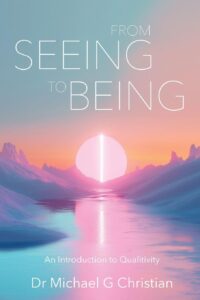
Quantum Photo Somatics is the method he built from that idea. Using calibrated light and prism, he works to bring the visual system into closer timing with the rest of the body, so the nervous system has less reason to stay braced. He describes this as redirecting the body’s process rather than treating a symptom, and he sets it out at length across two books, In Focus and the 2025 From Seeing to Being, alongside frameworks he has developed over decades, including phase coherence, the SEE Framework and the AIM Framework. The point worth holding onto is a simple one: because the work runs through the visual system, hands-on contact is not the mechanism. That is what makes a genuinely touch-free session possible rather than a version of hands-on work with the hands reluctantly withheld.
We should be equally clear about the status of this view. It is Dr Christian’s framework, grounded in decades of clinical observation, not a claim that has been through randomised controlled trials as a proven medical treatment. Those trials do not exist, and he does not pretend they do. What he offers is a coherent, experience-tested way of engaging the body that happens not to depend on touch, and an invitation to test whether it fits your own experience.
- In Dr Christian’s model, being braced can reflect a timing mismatch he calls a loss of phase coherence.
- QPS uses calibrated light and prism to support that timing, which is why touch is not the mechanism.
- This is his clinical framework, set out in two books, not a trial-proven medical treatment.
What Consent-Led Actually Means Here
Touch-free is only half of the promise. The other half is consent, and consent in this practice is a structured thing rather than a signature on a form. QPS draws on the Wheel of Consent, a well-known framework for making agreements about touch and physical space explicit rather than assumed. In plain terms, it means that anything involving your body is offered, understood and agreed before it happens, that you can say no to any part of it without needing to justify yourself, and that a yes given at the start of a session can be withdrawn at any point during it.
For someone who has felt handled, hurried or unheard in other settings, this changes the room. You are not a passive recipient waiting to see what will be done to you. You are the person setting the terms, and the practitioner’s job is to work within them. Touch, if it is ever part of a session at all, is offered as one option among others and only taken up if you want it. Nothing about the core work depends on your agreeing to be touched, which means saying no costs you nothing and takes nothing away from the session.
This is not a soft add-on to the modality. It is part of how QPS defines itself: a practice where touch is optional and always consent-based. For the audience this article is written for, that is not a nice-to-have detail. It is very often the whole reason the door is open at all.
- Consent here draws on the Wheel of Consent, making agreements about touch and space explicit rather than assumed.
- You can decline any part of a session without justifying it, and a yes can be withdrawn at any point.
- Touch, if offered at all, is one option among others; the core work never depends on it.
Accessible and Honest: Why We Say “May Support”
You will notice careful language all through this page. We say the work “may support” the nervous system. We do not say it treats, cures or fixes anything, and we are especially careful not to frame this as a way to resolve a difficult history. That is deliberate, and we would rather be straightforward about why than leave you wondering.
Quantum Photo Somatics is a complementary modality, not a medical or psychological treatment. In Australia, the law is strict about the claims a complementary practitioner may make, and rightly so, because the field has more than its share of people promising more than they can deliver. Dr Christian has built the opposite kind of practice: registered with the IICT since 2019, insured through the professional framework that registration provides, and board certified with the Board of Integrative Medicine in North America. Holding to “may support” is not a marketing hedge. It is the honest description of what a complementary modality can offer, and it is one of the clearest ways to tell a serious practitioner from someone selling certainty.
So the accessibility of this work and its honesty are meant to travel together. A touch-free, consent-led approach is genuinely more reachable for people whom hands-on therapy leaves out, and that is worth saying plainly. But accessible does not mean curative, and dignified does not mean guaranteed. QPS belongs alongside your medical and psychological care, and many clients keep seeing their GP or therapist while they explore it. If you are in distress or in crisis, the right first call is your GP or a mental-health service, and this work would only ever sit beside that support, never in place of it.
- “May support” is the honest, lawful description of what a complementary modality can offer.
- Accessible and consent-led does not mean curative; the work is complementary, never a replacement.
- If you are in distress or crisis, your GP or a mental-health service comes first, with QPS alongside.
Whether This Is Worth Exploring for You
The first step is a one-hour, in-person session in Melbourne CBD called a Quansultation. It is an exploration rather than a treatment, and its purpose is honesty: by the end of the hour you should have a clear sense of whether this approach speaks to what you are experiencing. There is no referral required and no commitment beyond that single session. During it, Dr Christian explores how your visual system is interacting with your sense of balance, movement and overall state, using calibrated light and prism, and the consent framework governs every moment, so you stay in control and touch is never assumed.
This tends to speak to people who want body-based work but have found the usual forms of it hard to accept, whether because of touch aversion, sensory sensitivity or simply a firm preference for their own physical space. If talk has helped your thinking without reaching what feels held in the body, and if hands-on work is a door you would rather not walk through, a touch-free, consent-led session may be worth an hour of your curiosity. It is not for everyone, it is not a replacement for the care you already have, and it makes no promises about outcomes. But if you have been looking for a registered, accountable, body-based approach that respects a plain no to touch, this is a calm and low-pressure place to start.
Read more on body-based work when talk therapy has not been enough
Frequently Asked Questions
Q: Can I really have somatic work in Melbourne without being touched?
A: Yes. Quantum Photo Somatics works through light and the visual system rather than hands-on manipulation, so touch is not the mechanism of the work. Touch is optional and offered only if you want it, and every session runs on a clear consent framework, so you can decline any physical contact and still take part fully. This makes the modality genuinely accessible to people for whom being touched is a barrier. It is a complementary modality that sits alongside your existing care, not a medical treatment.
Q: What does “consent-led” mean in a QPS session?
A: It means the arrangement is agreed and revocable at every step, drawing on the Wheel of Consent framework. Anything involving your body is offered and understood before it happens, you can say no to any part without justifying yourself, and a yes given at the start can be withdrawn at any point. You are the person setting the terms, and the practitioner works within them. For people who have felt handled or unheard elsewhere, that structure is often what makes the work approachable.
Q: Is this a treatment for trauma or a difficult history?
A: No. Quantum Photo Somatics is a complementary modality, not a medical or psychological treatment, and it does not claim to treat, cure or resolve any condition or history. It is designed to be accessible and dignified for people who find touch difficult, and it may support the nervous system, but it works alongside your medical and psychological care, never in place of it. If you are dealing with a difficult history, the right professional support comes first, and QPS would only ever sit beside it.
Q: Why do you say “may support” instead of promising results?
A: Because it is the honest and lawful description of what a complementary modality can offer. There are no randomised controlled trials presenting QPS as a proven medical therapy, and Dr Christian does not pretend otherwise. The careful language is a sign of a registered, accountable practice, not a lack of conviction about the work. A practitioner who promises to cure or fix you is a warning sign, not a reassurance.
Want to Learn More?
Quantum Photo Somatics is the work of more than three decades of clinical practice, a doctorate in integrative medicine, board certification with the Board of Integrative Medicine in North America, and two published books, including From Seeing to Being. If you want to understand how a session unfolds and how the touch-optional, consent-led structure works in practice before you decide anything, the pages below set it out in plain language and without pressure.
See what happens in a QPS session
Understand the full QPS approach
Citations
- “Nervous system, Better Health Channel”: Victoria’s state health service explains that the autonomic nervous system regulates the body’s glands and organs without conscious effort, and that the somatic nervous system relays information from the eyes, ears, skin and muscle to the central nervous system, the physiological basis for a body-based approach that works through the visual system. https://www.betterhealth.vic.gov.au/health/conditionsandtreatments/nervous-system
- “IICT Approved Modalities”: The International Institute for Complementary Therapists confirms that an approved modality has been assessed and approved by its insurance partners and is eligible for professional membership and insurance cover, the register QPS has held since 2019. https://www.myiict.com/approved-modalities/
As a registered complementary modality, QPS works within the IICT code of conduct and the Australian standards that govern complementary-therapy advertising, which require that no claims of cure or treatment be made.
✓Verified