July 13, 2026
Answering: What actually happens in a Quansultation, how much does it cost, and what should you bring?
Estimated reading time: 9 min read
A Quansultation is a one-hour, in-person first session in Melbourne CBD with Dr Michael Christian, and it currently costs $420 AUD. It needs no referral, it carries no commitment beyond the single hour, and it is framed as an exploration rather than a treatment. If you have read enough about Quantum Photo Somatics to be curious, and you are close to booking but want to know exactly what the hour involves and what it costs before you commit, this guide is written for you. Quantum Photo Somatics is a complementary somatic modality, registered with the International Institute for Complementary Therapists (IICT) since 2019 and developed by Dr Christian across 33 years of clinical practice and more than 43,680 documented sessions. It is designed to sit alongside the medical, optometric or psychological care you already receive, never to replace it.
Most of the hesitation people describe before a first session is not really about price. It is about the unknown: the room, the pace, what you will be asked to do, and whether you will feel any pressure to sign up for more. So this article walks through a Quansultation from the moment you book to the moment you leave, step by step, and answers the practical questions plainly. By the end you should be able to picture the whole hour and decide, calmly, whether it is worth your time.
Key Insights
- A Quansultation is a one-hour, in-person session in Melbourne CBD with Dr Michael Christian, currently $420 AUD, with no referral required and no commitment beyond the single appointment.
- It is an exploration, not a treatment. The work uses calibrated light and prism, and any touch is optional and governed by consent at every stage.
- Quantum Photo Somatics is an IICT-registered complementary modality that may support the nervous system alongside your existing care. It does not diagnose, treat or cure any condition.
Keep reading for the complete walk-through.
Table of Contents
- What a Quansultation Costs, and What That Covers
- Before You Book: What to Expect
- Your First Session, Step by Step
- What to Bring and What to Expect: A Checklist
- What a Quansultation Is Not
What a Quansultation Costs, and What That Covers
A first Quansultation is currently $420 AUD. That is a set fee for the single, one-hour, in-person session in Melbourne CBD, and it is the only cost involved in finding out whether the approach fits what you are experiencing. There is no separate booking fee, no charge for a follow-up you have not agreed to, and nothing you are asked to buy on the day. For people who return by choice, later Quansultations are $360 AUD, but that is entirely optional, and nothing about the first session assumes you will book another.
It helps to understand what that hour actually buys, because it is not a product in the usual sense. You are not paying for a prescription, a device, or a course of treatment. You are paying for an hour of Dr Christian’s attention and for the use of a structured, consent-led method he has refined over three decades. In his model, the session is an exploration of how your visual, neurological and somatic systems are coordinating, using calibrated light and prism as the tools of that exploration. What you leave with is clarity, a clearer sense of whether this approach speaks to your experience, rather than a promised outcome.
Because Quantum Photo Somatics is a complementary modality rather than a medical service, the Quansultation is not covered by Medicare, and you would need to check your own private health cover before assuming a rebate applies. This is normal for complementary therapies in Australia, and it is part of being straightforward about what you are paying for. The fee is fixed and known in advance, so you can decide on your own timeline, with no urgency attached to the choice.
- A first Quansultation is $420 AUD, a set fee for one hour, in person, in Melbourne CBD.
- Optional later sessions are $360 AUD; nothing on the day assumes you will return.
- As a complementary modality, it is not a Medicare service; check your own private cover.
Before You Book: What to Expect
Booking a Quansultation is deliberately simple. You do not need a referral from a GP or any other practitioner, and you are not signing up to a programme by choosing a time. The session is held in person in Melbourne CBD with Dr Christian, who developed this somatic modality across 33 years of clinical practice and more than 43,680 documented sessions. You choose a time that suits you, and the hour is yours to use.
There is very little you need to do to prepare. You do not need to bring prior test results, order anything in advance, or read a stack of material first, although you are welcome to mention anything relevant to your situation once you are there. It can help to arrive with a rough sense of what has brought you, in your own words, because a good deal of the first stage is simply describing your experience and being properly listened to. Beyond that, no preparation is required.
It also helps to arrive understanding what the hour is for. A Quansultation is not an eye test, and it is not an assessment of how sharply you read a chart. In Dr Christian’s model, it is a structured look at how your body organises itself around what you see, and how your visual system, nervous system and body are coordinating. For the thinking behind that approach, the complete guide to Quantum Photo Somatics sets out the background in plain language, and the walk-through of what happens in a session covers the experience in more detail.
- No referral is required, and booking a time does not commit you to anything further.
- No preparation is needed; you do not need to bring test results or order anything.
- It is not an eye test; it is a structured look at how your body organises around what you see.
Your First Session, Step by Step
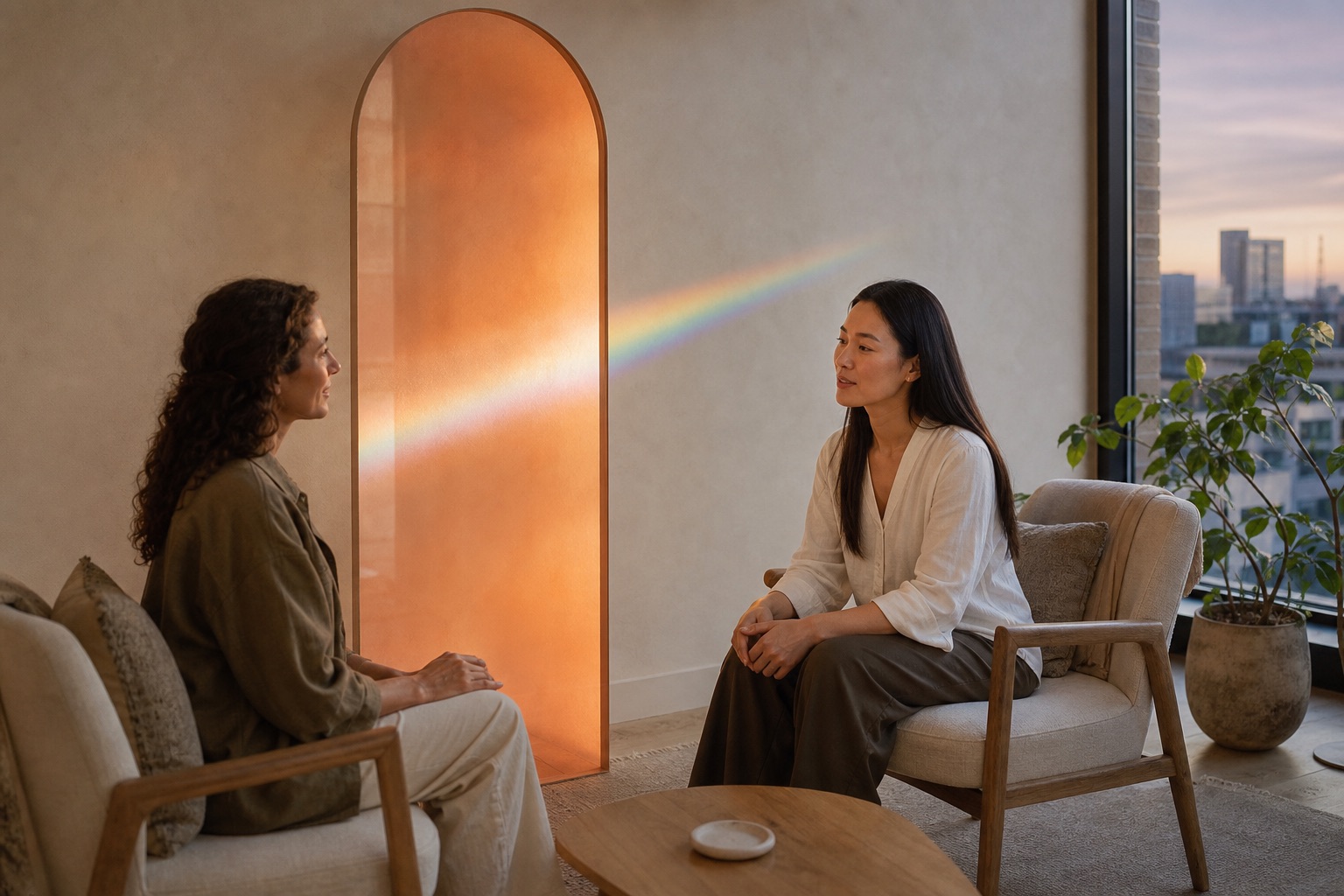
Within the hour, a Quansultation follows a clear structure that Dr Christian describes as the SEE Framework: Sense, Enable, Enact. Knowing the shape of the session in advance is often what settles the nerves, because at each stage you can see what is happening and why. The numbered steps below describe how the hour typically unfolds, from arrival to the end.
- Step one: Arrival and settling in. You arrive at the Melbourne CBD clinic and are welcomed into an unhurried space. There is no waiting-room paperwork marathon and no rush. Dr Christian explains what the hour will involve and how consent works, so before anything begins you already know that you can ask questions, decline any element, or pause at any point. This first few minutes exists to lower the temperature, not to process you.
- Step two: Sense, the opening conversation. The session proper opens with a conversation and an unhurried look at how your visual system is currently working, and how it organises posture, balance and your general state. Rather than relying on a standard chart alone, this stage pays attention to the quality of how you process what you see. It is your chance to describe your experience in your own words and to be properly heard, which for many people is a noticeably different pace from the appointments they are used to.
- Step three: Enable, working with light and prism. Next, calibrated light and prism are introduced to explore how small, precise changes affect the way your body processes visual information. This is the part most people are curious about. It is gentle, it is led at your pace, and nothing is done without your agreement. Some clients notice shifts in how they are holding themselves or in their sense of balance during this stage, and noticing is part of what the exploration is looking at, rather than a result you are expected to produce.
- Step four: Enact, letting your system settle. The session then gives your own system room to settle around anything new it has noticed. In Dr Christian’s model this is framed as something your body does for itself once the conditions are in place, rather than something performed on you. The emphasis is on understanding your particular pattern, not fitting you to a fixed protocol, and on leaving you with a clearer picture of what you noticed during the hour.
- Step five: Close and next steps, with no pressure. The hour ends with a calm conversation about what you noticed and what, if anything, you would like to do next. There is no sales pitch and no urgency. You are free to go away and think, to book a follow-up if and when it suits you, or to decide the approach is not for you. The decision is entirely yours, and the point of the session was to give you the clarity to make it.
Across all five steps the tone stays calm and conversational. You are never rushed, and you are free to ask questions at any point. You can read more about the structure on the session walk-through page, which covers the same three-part framework in greater depth.
What to Bring and What to Expect: A Checklist
If you like to know the practicalities before you walk in, here is the short version in one place. Nothing on this list is onerous, and the honest answer to “what do I need to bring” is very little.
What to bring:
- Yourself, on time, and if you wear glasses or contact lenses, wear them as you normally would.
- A rough sense, in your own words, of what has brought you and what you have already tried. You do not need to write anything formal.
- Any prior test results only if you happen to have them and want to mention them. They are genuinely optional and not required.
- The set fee of $420 AUD for the session; there is nothing extra to buy on the day.
What to expect:
- One hour, in person, in Melbourne CBD, with Dr Michael Christian.
- An exploration rather than a treatment, using calibrated light and prism, with any touch optional and consent-based throughout.
- A calm, unhurried pace, with room to ask questions and to pause or stop at any time.
- No prescriptions, no lenses to order, and no commitment to return.
- Clarity about whether the approach fits your experience, rather than a promised outcome.
On the matter of touch and consent, it is worth being explicit, because it is often the deciding factor for people who have found hands-on work difficult in the past. Any touch in a Quansultation is optional, and consent governs every stage. Many body-based practitioners draw on what is known as the Wheel of Consent, a framework for making bodily boundaries explicit and renegotiable in real time rather than treating consent as a single yes or no at the door. In practice this means you can ask what something involves before it happens, decline any element, and pause or stop without needing to justify it. The work centres on light and prism and on how your visual system interacts with the rest of your body, so it does not depend on hands-on contact at all.
What a Quansultation Is Not
Being clear about what a first session is not is just as useful as describing what it is. A Quansultation is not a medical appointment, and it does not diagnose or treat any condition. It does not involve prescriptions, and you will not leave with lenses to order. It is a complementary somatic exploration, which means it is designed to sit alongside the medical, optometric or psychological care you already receive, never to replace it. There is a solid physiological reason the body can respond to structured, sensory input of this kind. According to Victoria’s Better Health Channel, the somatic nervous system carries sensory information from the eyes, ears, skin and muscles to the central nervous system, while the autonomic nervous system regulates the body without conscious effort. The visual system, in other words, is closely wired into the systems that govern balance and the body’s automatic responses, which is the territory a Quansultation explores. Even so, the work may support the nervous system rather than treat it, and any experiences clients describe are shared as lived experience, not as guaranteed results.
It is also not a commitment. You are not signing up to a course of sessions by booking the first one, and there is no pressure to return. Many people use the hour simply to understand the approach in Dr Christian’s own terms and to decide, in their own time, whether it is something they want to explore further. That freedom is deliberate, and it is part of why the session is structured as a single, self-contained appointment with a known, fixed fee. If you would like to understand the thinking behind the work before you book, the complete guide sets it out plainly, and when you are ready, a Quansultation is a low-pressure place to start.
Frequently Asked Questions
Q: How much does a Quansultation cost, and how long is it?
A: A first Quansultation is currently $420 AUD and runs for approximately one hour, in person in Melbourne CBD with Dr Michael Christian. It is a set fee for a single session, with no separate booking charge and nothing extra to buy on the day. Optional later sessions for people who choose to return are $360 AUD, but the first session assumes no commitment beyond the hour.
Q: Do I need a referral, or am I committing to ongoing sessions?
A: No referral is required to book, and you are not committing to anything beyond the single appointment. A Quansultation is a self-contained hour designed to give you clarity about whether the approach suits what you are experiencing. Many people use it to understand the modality and then decide, in their own time, whether to explore further. There is no pressure either way.
Q: What should I bring, and how do I prepare?
A: Very little. You do not need to prepare anything or bring prior test results, although you are welcome to mention anything relevant. If you wear glasses or contact lenses, wear them as normal. It can help to arrive with a rough sense, in your own words, of what has brought you. The session is an exploration of how your body organises around what you see, not an eye test.
Q: Will I be touched during the session?
A: Any touch is optional, and consent governs every stage, so you remain in control throughout. The work centres on calibrated light and prism and on how your visual system interacts with the rest of your body, rather than on hands-on contact. You can ask what something involves, decline any element, or pause at any time. For people who find hands-on therapy difficult, this is a deliberate feature of the work.
Q: Is Quantum Photo Somatics a medical treatment?
A: No. Quantum Photo Somatics is a complementary modality, registered with the IICT since 2019, and it does not diagnose, treat or cure any condition. It may support the nervous system alongside the medical, optometric or psychological care you already receive, never in place of it. Any experiences clients describe are shared as lived experience, not as guaranteed outcomes.
Want to Learn More?
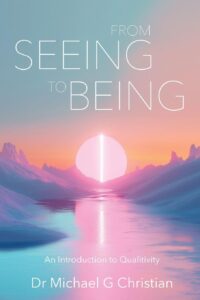
Quantum Photo Somatics is the result of more than three decades of clinical practice, a doctorate in integrative medicine, and two published books, including From Seeing to Being. Dr Christian is board certified with the Board of Integrative Medicine in North America and has been registered with the IICT since 2019. If you would like to understand the thinking behind the work before you book, the complete guide and session walk-through set it out in plain language, written for people who want to understand before they decide.
Citations
- “Nervous system, Better Health Channel”: Victoria’s state health information service explains that the somatic nervous system carries sensory information from the eyes, ears, skin and muscles to the central nervous system, while the autonomic nervous system regulates the body without conscious effort, the physiological basis for working through the visual system. https://www.betterhealth.vic.gov.au/health/conditionsandtreatments/nervous-system
- “IICT Approved Modalities”: The International Institute for Complementary Therapists confirms that an approved modality has been assessed and is eligible for professional membership and insurance, the register Quantum Photo Somatics has held since 2019. https://www.myiict.com/approved-modalities/
As a registered modality, Quantum Photo Somatics operates within the IICT professional code of conduct and the general standards that apply to complementary therapy advertising in Australia, which require that no therapeutic claims of cure or treatment be made.
✓Verified